2026 - our 27th Year!
[For daily omer reminders and Jews on The Simpsons stuff, follow us on Instagram (@CountTheHomer) and on Facebook (@homercalendar)]
[For daily omer reminders and Jews on The Simpsons stuff, follow us on Instagram (@CountTheHomer) and on Facebook (@homercalendar)]
About Counting the Omer
 n the second day of Passover in
ancient times, our ancestors brought the first sheaf of barley
(amounting to a measure called "an omer") reaped that season as
an offering to God. From that day, they began counting the 49
days to Shavuot, when they would celebrate the beginning of the
wheat harvest by offering loaves made of the first wheat.
Even after the Temple was destroyed and offerings were no longer
brought, they continued to count the days from Passover to
Shavuot in accordance with the biblical injunction (Lev. 23:15).
n the second day of Passover in
ancient times, our ancestors brought the first sheaf of barley
(amounting to a measure called "an omer") reaped that season as
an offering to God. From that day, they began counting the 49
days to Shavuot, when they would celebrate the beginning of the
wheat harvest by offering loaves made of the first wheat.
Even after the Temple was destroyed and offerings were no longer
brought, they continued to count the days from Passover to
Shavuot in accordance with the biblical injunction (Lev. 23:15).
In this way our ancestors linked Passover and Shavuot as occasions for thanking God for the fruits of the field. We, too, thank God for the renewal of life which nature proclaims at this season.
However, as Passover and Shavuot acquired historical significance, their linkage through the counting of the intervening days took on new meaning. Passover celebrates the liberation from Egypt, and Shavuot celebrates the receiving of Torah at Sinai. By counting the omer, we symbolically connect liberation with the idea of Torah.
Counting the omer is an exercise in the discipline of mindfulness. Counting each of the days of the omer reminds us that all of our days are numbered, and it is our responsibility to make each day count.
The Counting Ritual (D'ohs and Donuts)
 ach
evening, while standing, one first recites the blessing for the
mitzvah of counting, and then declares the number of days and
weeks of the omer count. Traditionally, if one forgets to count
at night (D'oh!),
the count may be made the next day without a blessing. One then
resumes the regular count that evening. If, however, one skips
an entire day, then orthodox practice is to continue counting
until Shavuot, without the blessing (but see this).
ach
evening, while standing, one first recites the blessing for the
mitzvah of counting, and then declares the number of days and
weeks of the omer count. Traditionally, if one forgets to count
at night (D'oh!),
the count may be made the next day without a blessing. One then
resumes the regular count that evening. If, however, one skips
an entire day, then orthodox practice is to continue counting
until Shavuot, without the blessing (but see this).
 How To Use This Site
The Homer Calendar can guide you through the
counting of the omer in three ways:
1) Click
on each of the individual days in the calendar below to see
the blessing and count for that day. Remember, however, Jewish
"days" start in the evening, so one shouldn't count the omer
for a day in the calendar until after sundown on that date.
2) Click
on each of the weeks in the far left column below to open a
two-page document (pdf format) you can print out. These
pages have the blessing and the count for each day of
the omer for that week.
3) View
and print out a one-page pdf Homer Calendar with the count
for each day of the omer for this year by clicking
here.
Check out our extras and links below for all things Jewish and Simpsons.
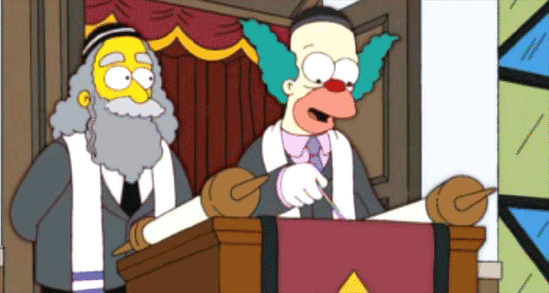
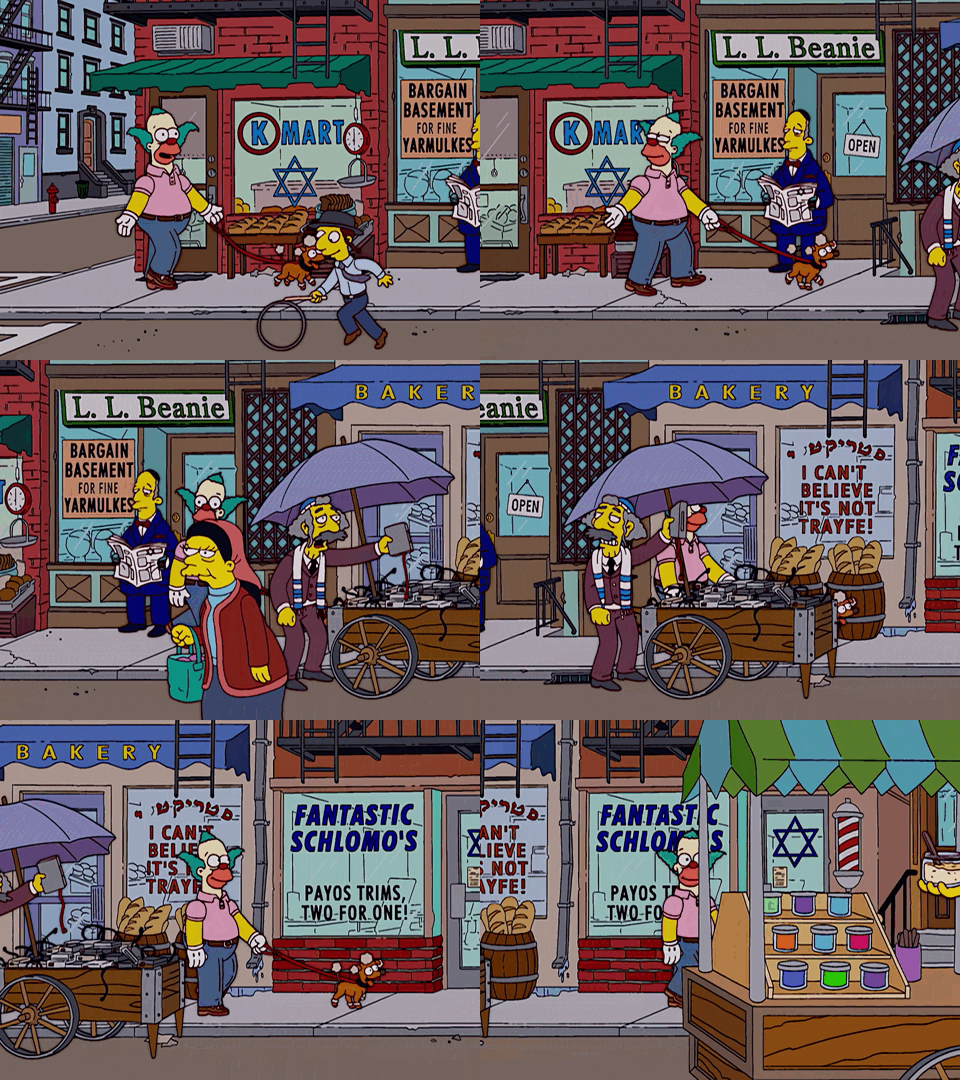 From Temple Beth Springfield to the Springfielder Shvitz, the Jews of Springfield have a proud heritage. Click to see the photo essay / slide show, "Jewish Life in Springfield" (Expanded and updated in 2023) (All pictures original, actual screens from Simpsons episodes) |
 |
Hey Hey Hey! You can kibbitz, kvetch or kvell on our Facebook page. |
About this site and more
about the Simpsons & Jews, and the Omer
(Thanks to Howard Cooper for the
original idea. Also thanks to our original host, the departed JVibe.com, and its publisher, solar energy pioneer Green Rebel / Kaptain Sunshine and Jewish peoplehood promoter, Yosef Abramowitz.)
Now in our 27th (that's a big number) year, this site was
created by Brian P. Rosman (email: homercalendar@mail2homer.com), with help
from Aviva and
Yonah Rosman and Rabbi Barbara Penzner (woo-hoo!). When we started, we got a "cease and desist" demand from Fox, claiming a copyright violation. Interestingly, the letter was dated davka exactly on Shavuot, reminding us of the old joke about the judge giving someone 8 days to take down an
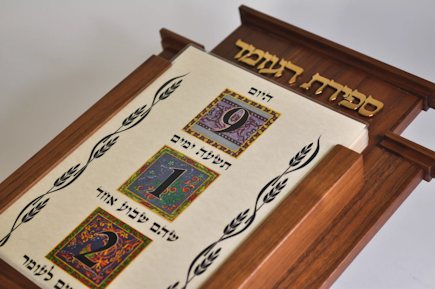
illegal sukkah. We wrote back, claiming the site qualified as a "fair use," and haven't heard anything since. We could also have argued that the word "homer" is just the way you say omer in Ladino, the Spanish-Hebrew language used by Jews from Spain, at least according to this 18th century omer counter from Congregation Mikveh Israel in Philadelphia (or this one).
We've had lots of press interest since we started in 2000. The Boston Jewish Advocate wrote the first feature story on the site, and we were reviewed early on in the Jerusalem Report, Jerusalem Post (twice!), and the now defunct USAJewish webzine (calling us "the Web's coolest religious Jewish site"). In 2005 the New York Jewish Week published an article about us and then in 2012 we were covered in their tech blog. The 2005 story led to a bizarre interview on Washington DC's Sunday morning Jewish radio show, "Awake, Alive and Jewish" (click here to listen [mp3]). We also got the OU (Orthodox Union) hechsher of approval - read their supportive yet cautionary review in the OU's Jewish Action magazine. We were "Web Site of the Week" on Jewish.com (before it became a kosher food and then Israeli ambulance support site), and were named a "Top Site" in March 2002 by the Jewish Agency. We had a coverage bonanza in 2017, when JTA's The Jewniverse wrote warmly about us; then Tablet Magazine published a detailed Simpsons-fan oriented interview; and then right afterwards The Forward ran a short piece, mostly drawing from the Tablet article, that (accurately) called us "charmingly rudimentary" (hey - I do this all by hand, [except with some new help this year from Rav Claude]). Thankfully, B'nai Zion Congregation in Shreveport, Louisiana advises that the Homer calendar is "way better than you think."
In 2019, the blog Pop Cholent did a long, loving interview, asking how the Calendar got started, whether it really encourages kids to count the Omer, and our favorite Jewish moment in the show - you really should read it, here.
We also did an interview in 2026 with Steve Sheffey's newsletter on American politics about Israel. Steve called us "pure genius," the "indispensible Homer Calendar that belongs in every Jewish home." He asked questions about the evolution of Jewish humor and the work of preparing the Calendar. You can read it here. All of the press coverage of the Homer Calendar site is available here.
Shkoyach also to Reddit user jaanku who had the same idea -- 29 years ago(!) and made a very cute Counting of the Homer poster as an extra credit project for school. His teacher laminated it and still uses it in class.
And thanks also to Rabbi Ruth Adar's Reform Judaism's Omer guide; The Jewfaq.org's Judaism 101 omer page ("an amusing (yet still accurate!) Simpsons-themed discussion of the Omer along with an Omer calendar"), Congregation Beth Shalom in Sacramento, California; Congregation Beth Ahm in West Bloomfield, Michigan; Temple Beth El in Portland Maine; Congregation Beth Israel in Colleyville, Texas; Rabbi Jason Miller; the Delicious Jerusalem blog; and Michael Radwin for their links and support.
All things Jewish and Simpsons
We must acknowledge upfront that Homer himself is not Jewish, although he isn't always sure about it (perhaps it's the frequent mention of a homer in the Hebrew Bible). More traditional Jewish writers have used Homer as a foil, demonstrating the opposite of what a Jewish man should be (Aish.com: "What kind of man does a woman really want? Hint: It's not Homer Simpson.").
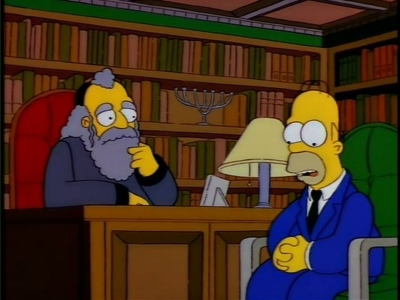
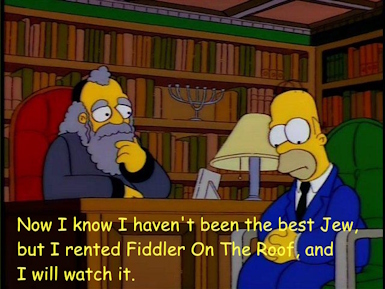
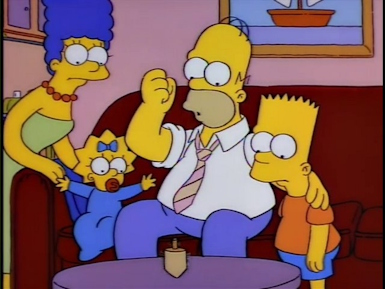
Yet inexplicably, in a 2000 episode, the kids find a menorah in his closet: Homer once tried playing a Jew, hoping for some cash. He tells the Rabbi, "Now I know I haven't been the best Jew. But I rented Fiddler on the Roof, and I will watch it." It didn't work, but he did get a dreidel: (Aside - speaking of, it's worth watching the family reenact a scene from Fiddler - watch below: (and Sunrise, Sunset came up here (YouTube clip), also) As you'd expect, around half of the show's writers are Jewish, says showrunner/writer Mike Reiss (see How Mike Reiss Converted The Simpsons To Judaism), who speaks around the world on The Simpsons and the Jews. One of the Jewish producers/writers, Emmy-winner David Sacks, spiritual leader of the neo-Hasidic LA Happy Minyan, told Rabbi Mark Wildes how he kept Shabbos as a writer on the show, recounting how he would quietly sneak out of the writers' room early on Friday; he learned later the other writers called him the "Invisible Jew." In addition to Reiss, most of the original creative team were Jewish (Reiss, James L. Brooks, and Sam Simon), and so are three of the four lead voice actors. Hank Azaria's (voices the Jewish Duffman, along with many others) grandparents on both sides were Sephardic Thessalonian Jews and his family spoke Ladino; Harry Shearer's (the Jewish Kent Brockman (née Brockelstein) among many; here's Brockman with a chai necklace, which was attacked by an otter in a 2024 episode as he cries out "My Chai") parents were Jewish immigrants from Austria and Poland; and Julie Kavner (voices Marge and many others) are all Jews. Ironically, non-Jew Dan Castellaneta does the voice of Krusty (and Homer).
Reiss says, "The place is sort of like a kibbutz, only more Jewish." Homer figured out he wasn't Jewish in a 1995 episode, after the family sees the Rappin' Rabbis on TV, who sing, "Don't eat pork, not even vit a fork - Can't touch this!" (YouTube clip). This leads Homer to ask, "Marge, are we Jewish?" You won't believe in what happens next:
So yes, lots of folks around Springfield are max goyish. Of course, there's Reverend Lovejoy, who talked Marge into a scheme, saying, "Relax, Marge. If God lets the Jews have Sunday on a Saturday, he'll be cool with this."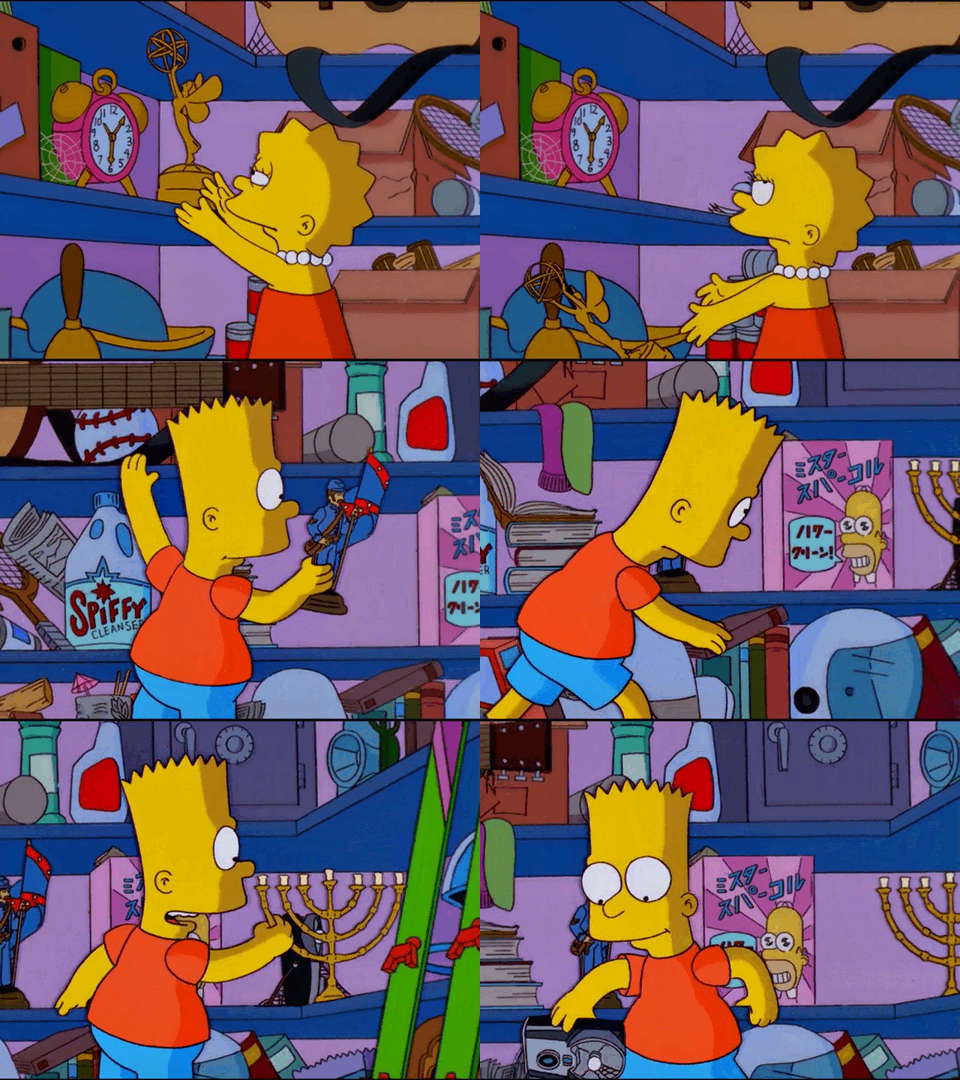
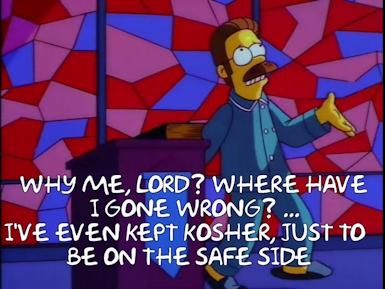
Why me, Lord? Where have I gone wrong? I've always been nice to people. I don't drink or dance or swear. I've even kept Kosher, just to be on the safe side. I've done everything the Bible says, even the stuff that contradicts the other stuff. (watch)
(Ned also declared he and his family were Jewish after Homer stole his mustache, prompting a hearty "L'Chaim!" from his kids: YouTube clip)
And so Bart knew just where to go when it came time to pick a religion: "How about Judaism? When you turn 13, cha-ching!" (video clip).Though Homer and family are not one of us, the now defunct Hipster Jew site had a great summary of all the Jewish characters in the show, including some questionable, but totally defensible, honorary Jews. And, see this exhaustive Simpsons Wiki list, of Jews who were ever on the show, with 70 entries, from Bob Dylan (who says "shalom" in the midst of an incomprehensible answer about his religion (YouTube clip) to the "Matzo Ball Soup Chef" and including the faceless Jewish God (who - unlike everyone else - has five fingers!), and, ahem, Jesus). Strangest of all is the "Old Jewish Man" with his dance craze (videos here and here).
In 2015, the Jewish Week also compiled their top 5 Jewy moments of the show, in Meet the Simpsteins; and the Forward did the same thing, picking out their Top 3 in 2020. YouTuber FitNerdyJew compiled his list of the 10 best Jewish Simpsons quotes, with clips, here. Writing in the Forward in 2014, Simpsons/Jews guru Mark Pinsky concludes, "For 25 Years, The Simpsons Have Been Good for the Jews, and in 2015 he further analyzed the clan in Moment, "The Simpsons have skeletons in their closet. And they're shaped like menorahs..... Along the same vein, a shrei-out to Robert Schneider at bangitout.com, who compiled this exploration of the characters' Jewishness: The Simpsons, Jewish? And a big mazel tov to Sophia Singer, whose 2015 B'nei Mitzvah project for the The City Congregation for Humanistic Judaism in New York was an essay on "Jewish Values and Themes in The Simpsons."
The Jazz Zinger
The first and greatest Jewish-themed episode aired in the third season, in 1991. We learn that Krusty the Clown is Jewish, and that his father is a rabbi. The Rabbi is voiced by Jackie Mason, who won an Emmy for Outstanding Voice-Over Performance for his performance as Rabbi Krustofski. (click in box to expand this section)
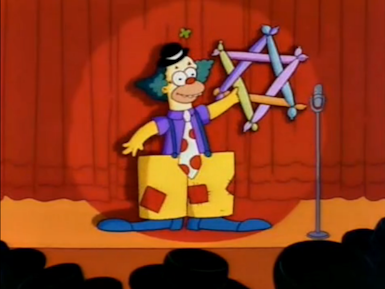
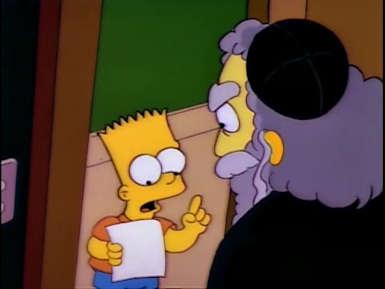
The episode, titled "Like Father, Like Clown," (videos for all shows are on Disney+, but you can purchase individual episodes on YouTube; see also Wiki entry; detailed fan dissecton and commentary; some audio clips; and every image with the full script) reveals that Krusty is Jewish, and introduces his father, Rabbi Krustofski. The episode starts with Krusty saying the motzi prayer before having dinner with the Simpsons. Really. Watch:
Krusty explains that he has long been estranged from his rabbi father, who told him, "Seltzer is for drinking, not for spraying. Pie is for noshing, not for throwing." This despite young Krusty being named, according to his father, "first in his yeshiva class -- as a matter of fact, he was voted the most likely to hear God."
Bart and Lisa try again and again to reconcile Krusty with his father, bringing serious Jewish sources. After trying some real Talmud, Bart finally finds the quote that works:
Bart: Rabbi, did not a great man say and I quote, "the Jews are a swinging bunch of people. I mean, I've heard of persecution, but what they went through is ridiculous. But the great thing is after thousands of years of waiting and holding on and fighting they finally made it." End quote.That does the trick. Rabbi and boychick embrace.
Rabbi: I never heard the plight of my people phrased so eloquently. Who said that? Rabbi Hillel? Judah the Pious? Maimonides? Ooh, I got it! The Dead Sea Scrolls!
Bart: I'm afraid not, Rabbi. It's from Yes, I Can, by Sammy Davis Jr. An entertainer, like your son.
Rabbi: The candy man? If a performer can think that way, maybe I'm completely upside down on this whole problem. Oh, all the years of joy that I've lost! Why? Because of my stubborn ways... [Begins to cry]
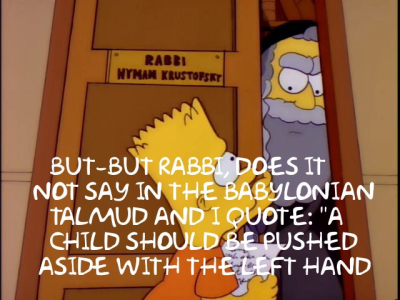
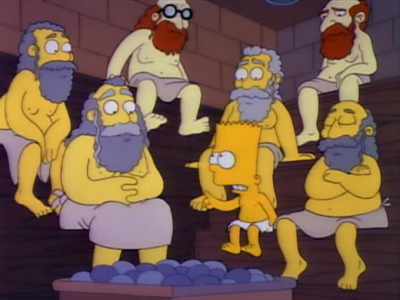
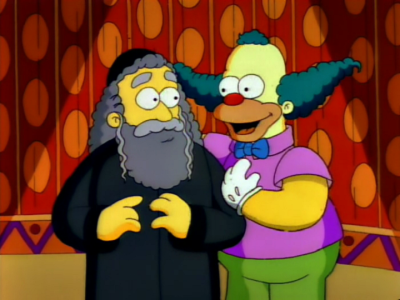
For Iranian Jewish immigrant Tabby Refael, seeing the first Rabbi she'd ever seen on TV as a girl in 1991, not long after coming to the US, was a personal turning point. She explains in a 2025 Jewish Journal essay:
The 1991 Simpsons episode "Like Father, Like Clown" marked the first time I saw a rabbi on television, and though I was a little girl and not a rabbi, I felt strangely seen.
Depictions of rabbis and other Jews, such as those in "Yentl" or "Fiddler on the Roof," didn't exactly make the cut in TV program lineups or movie theaters in Iran after the Islamic Revolution. I knew I was in America the moment I saw Rabbi Hyman Krustofsky embrace his long-lost son, Herschel, otherwise known as Krusty the Clown, in that episode. ... I realized that for the most part, Springfield was a safe town in which to watch positive depictions of Jews. Having escaped the rabid antisemitism of post-revolutionary Iran, it was a good feeling.
Not yet fluent in English and still struggling to understand the fair-skinned, light-haired community of Jews called Ashkenazim I had been introduced to, I nevertheless sat on our faux Persian rug in our small Los Angeles apartment, stared up at our bulky television set, and happily managed to identify every Jewish name on the list of credits at the beginning and end of each episode of The Simpsons.
Mike Reiss? Sounded Jewish. Sam Simon? Had to be a Jew. Josh Weinstein? Please. Conan O'Brien? Not so much. But his name already sounded like he would be funny.
In a moving 2023 essay, Diana Moskovitz describes how her Hebrew day school would reward kids with "video day." The videos had to be Jewish, so the choices at the time were The Ten Commandments, Fiddler on the Roof, and what she called the "Krusty Is A Jew" episode of The Simpsons. She saw the episode repeatedly as a kid in school. After rewatching it now, she identified "what made the episode so beloved, and so surprisingly appropriate for showing to young Jewish kids. It is thoroughly, deeply, and unapologetically Jewish."
[I]t is nice to not have to explain sometimes, to just feel normal. I think that's what still makes the "Krusty is a Jew" episode so special for me. Nothing is explained. Nothing is given context. Jews are just Jews, nothing we do is clarified or justified - and if you don't get it, well, we've got five more jokes coming, so buckle up and jot it down so you look it up later. And that might be the most Jewish part of it all.Read her essay for much more on how she see the episode.
Nathan Rabin explains in the AV Club that Krusty's Jewishness was somewhat of an accident:
Krusty's Judaism is reportedly something of a happy accident.... In retrospect, Krusty had to be Jewish. A gentile Krusty would be inconceivable. For Krusty represents and embodies a potent archetype: the crass Jewish show-business vulgarian who gains the world by losing their soul.
Krusty is a proxy for every Jew who ever distanced himself from hardscrabble immigrant roots by shortening their name and ridding themselves of anything redolent of the old country. He's every Catskills joke-slinger who recreated himself in an image he thought gentile America would find palatable. Krusty had to be Jewish and if Krusty has to be Jewish then he has to do a Jazz Singer episode. And if Krusty has to be Jewish and has to do a Jazz Singer episode then it follows that Jackie Mason, professional Jew, has to play his rabbi father.
Two rabbis assisted with the script, Lavi Meier and Harold M. Schulweis, and it shows, with lots of serious real rabbinics slipped into the story. Mike Reiss told Mark Pinsky that "we had three rabbis on the payroll. They were working with us all week to make sure we got it biblically correct." Florida Rabbi David Wolpe told Pinsky, "I thought the episode was brilliant, first of all, because of the use of real Jewish sources. Second of all, because it was an interesting take on the greatest of contemporary Jewish dilemmas, which is the battle between tradition and modernity." Wolpe said he got puzzled phone calls from parents when he assigned his Hebrew High School class to watch the episode.
The real rabbinics in the show led Rabbi/lawyer Noah Gradofksy to create "The Simpsons Talmud" page. He turned the Jewish content of the episode into into a full Talmud page in Hebrew and Aramaic, with Rashi and Tosafot too (see this pdf for the page laid out like the real thing). It's all translated and explained, and is truly brilliant. Also see this article from the NJ Jewish News for more on the episode, including evidence that Krusty is illiterate in English, but can read and write ... in Hebrew.
One grad student wrote that this episode changed his life and made him proud to be Jewish. Discovering that Krusty was Jewish - that he even said the motzi prayer, in Hebrew - was everything:
Because to that little Jewish kid sitting in front of his TV that just found out he was different from other people, seeing that one of the funniest characters on your favorite TV show was Jewish meant the world.
It was cool to be Jewish if Krusty the Clown was Jewish. …
This is a lesson I carried with me my entire life. I wrote my college essay about the inspiration this had on me. I even had a Simpsons-themed Bar Mitzvah. No joke. I have sweatshirts that say "Bart Mitzvah" with a picture of Bart Simpson on it. [see examples below]
All because a fictional character said a prayer over dinner in Hebrew. Thanks, Krusty.
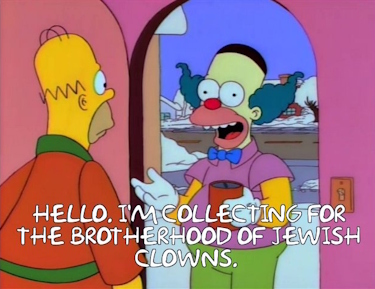
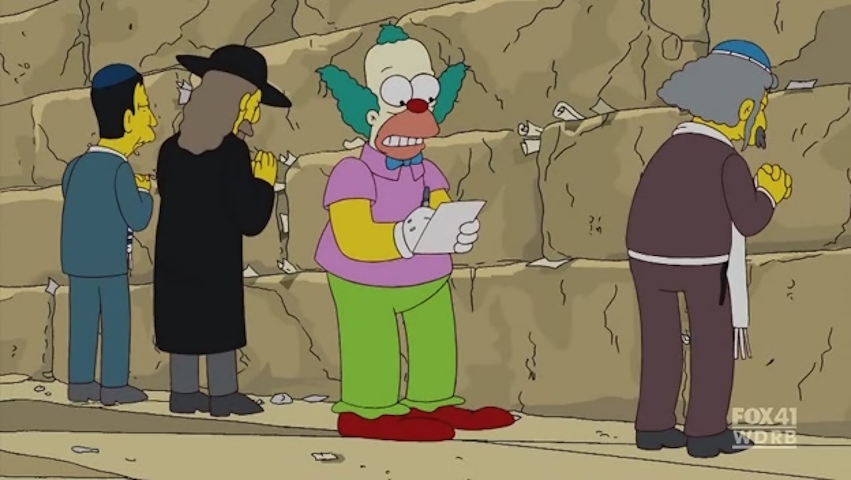
Krusty's devotion to his people was demonstrated when Krusty went door to door collecting for the Brotherhood of Jewish Clowns (video clip): Last year, tornadoes claimed the lives of 75 Jewish clowns. The worst incident was during our convention at Lubbock, Texas. There were floppy shoes and rainbow wigs everywhere! (Sobbing) It was terrible! And of course his aunt Sadie called him "Herschele" in a December 2024 episode, and he calls his daughter "you lucky little hamentashen" (watch).
Krusty's yiddishkeit was emes on display in a December 2016 episode. He's sick in the hospital, talking to his estranged daughter, Sophie:
Krusty: The whole megillah is a big tzimmes
Sophie: Tzimmes? Megillah?
Krusty: It's Yiddish, the language of our fakakta people
Sophie: Mom raised me Christian
Krusty: A Christian! Oh, the farbissina shiksa! How can you ignore the sacred traditions of the Jewish people?
Nurse (bringing in a sandwich): Krusty, here's your bacon, lobster and treif sandwich. (see picture here, of course with a glass of milk)
Krusty: Hey! It was supposed to come with a side of camel, extra cloven! (watch video)
Krusty's love for treif is a reliable trope. This was established back in 1991, when we learned the Krusty the Clown sandwich at Izzy's Deli is ham, sausage and bacon, with a smidge of mayo, on white bread (here's someone trying to make it). Or like in a May 2019 episode where Krusty goes into a room marked "Things Dad Told Me Not To Do" (there's a Christmas tree, a blow-up doll, and a pig hanging on hook). After Krusty's Rabbi father says (on TV) that Krusty's still a disappointment, Krusty grabs a lobster, dips it into mayonnaise, and starts eating (see picture here). Or when Krusty is sitting with his father, who is preparing Krusty for his Bar Mizvah: "Now, you can't mix milk and meat. You got that? And on Christmas day, you must eat Chinese food. And pork is strictly forbidden." You know what comes next:
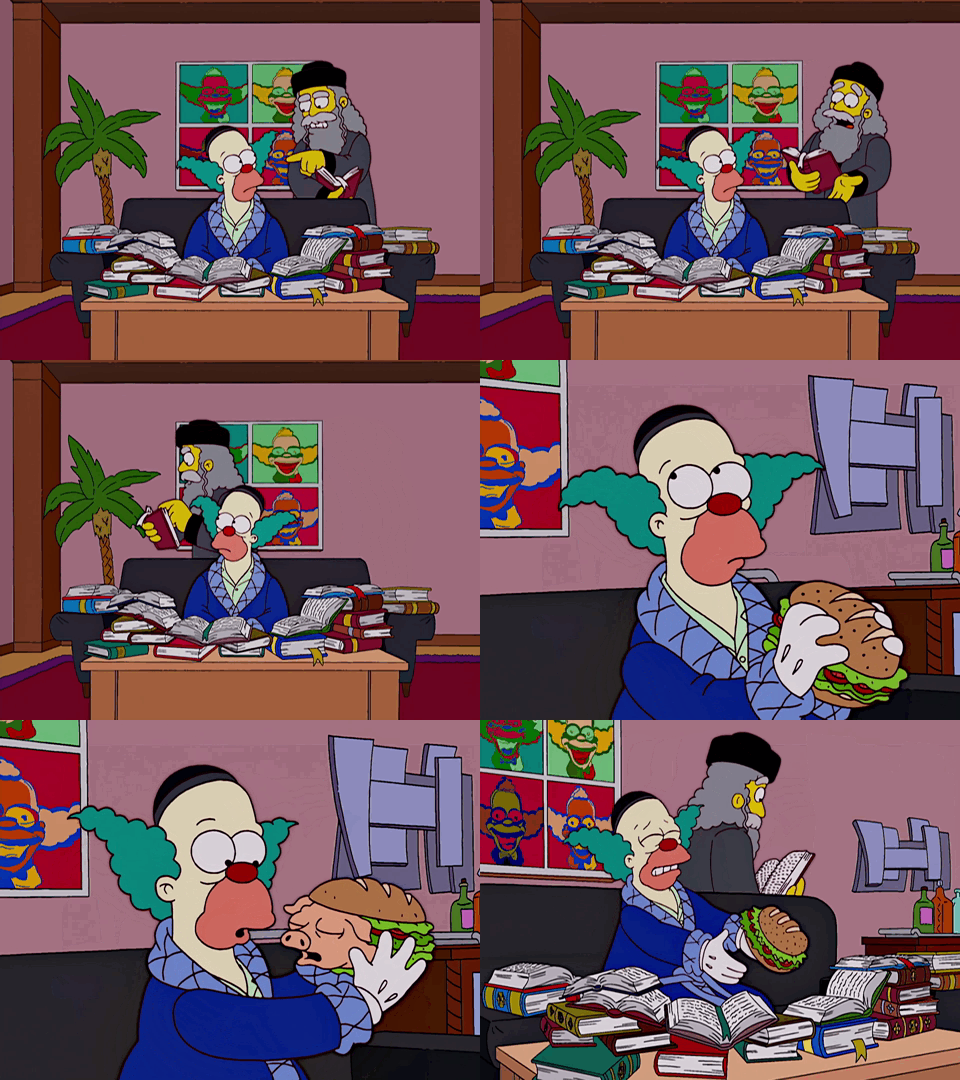
... and then:
Krusty didn't always embrace his mishpocha. In a 1993 episode, Krusty hosts the Italian Chef for the cooking segment on his show (see it):
Chef: Now, Krusty, I hear it's your birthday. So, I got your mother's recipe for matzo balls.
Krusty: Hey, I don't do the Jewish stuff on the air...
Chef: But, Herschel, bubelah...
Krusty: Ix-nay on the Ew-jay.
Krusty also shut down some antisemitism in a 2007 episode. While walking down the street, some hillbilly kids see him and point:
Kid: Hey! You're one of those funny people with a big crazy nose!See 11-second Youtube video here.
Krusty: A clown?
Kid: No, a J...
Krusty quickly interupts, loudly: A joker! That's right! And I'm not a practicing joker, so I'm not that offended.
Krusty's yiddishkeit came out again in December 2019. The Simpsons family goes to a Christmas theme park. In addition to Santa and elves, there's a Chanukah Hollow, with dancing latkes and a guy in a menorah suit (see picture). Kids dodge the jets of lamp oil spraying up from the ground. Nearby is the Dreidel Casino. Krusty is there (see him), putting all his chips on one lucky spin: "Come on, gimmel, gimmel, gimmel! Ah, shin again! I thought this would be the one part of Judaism I'm good at." (see the dreidel betting table).
Or, an October 2022 episode had two Krusty↔Jews bits. In one, Krusty's manager tell Krusty he's behind in his Cameo personalized video recordings for fans. So he opens up his phone and starts recording a video: "Hey hey, Jacob -- Your dad's super sad that he couldn't make it to your bar mitzvah. It's a real shanda. Also, all the best from dad's new wife, Shanda." (laugh turns into a sigh) (watch). And later, Krusty becomes a feared demanding boss of his new TV show, but he's exposed when the workers publicly complain. One says, "I heard he made all the interns convert to Judaism and work on Christmas, then convert back and work on Passover."
Krusty also released a video game, called "Krusty's Kosher Karnival," with a home screen showing Krusty as a Hasid and Krusty juggling Torah scrolls, with a lion jumping through a giant bagel hoop. A disclaimer notes, "Absolutely not Kosher." See it here.
Or this one from May 2023: Krusty opens up a Clown School. Facing a crisis, he talks to a picture of his Rabbi father, which has an inscription: Hyman Krustofsky -- Rabbi, Teacher, Disapproving Father (see picture). Krusty asks his father for a sign that all will be well, but the picture remains mute. In the end the whole school burns down.
Bart, his star student, tries to cheer up Krusty, asking, Do you want to get some nachos?
Krusty responds with glee: Did you say nachas, the Yiddish word for fatherly pride?
Bart: No, I said nachos, the Mexican word for cheese-covered chips.
Krusty: It's a sign from my father. (He looks up to the sky) My father finally has nachas!
Somewhat obscure Jewish gags have continued in recent years. A 2021 episode had Homer at Moe's Bar, celebrating a birthday. Marge calls, angry that Homer isn't home for dinner. Homer explains that it's a birthday, and Marge complains that there's always some celebration or another. Lenny then displays an olive branch, with a dreidel tied to one bough, and pipes in, “Don't forget Tu B'shvat, the Jewish Arbor Day!” (see picture here). In 2022, while walking on the hip street, Lisa spys the Kosher Pacific surf shop, with shirtless, swim-suited, long-coat (bekishe? rekel?) -wearing haredi mannequins in the window saying “Kabbalah-bunga“ and “L'chaim Ten!“ and “Glatt's Up!“ (see picture). Or a 2026 episode where Marge politely insults someone by calling them a "J-E-R-Kosher sign." And in the going right to edge category, an April 2022 episode showed the family watching a new streaming TV service called Everything+, which includes several channels, including one with Holocaust documentaries, called ... "Your Shoah Shows" (see the screen).
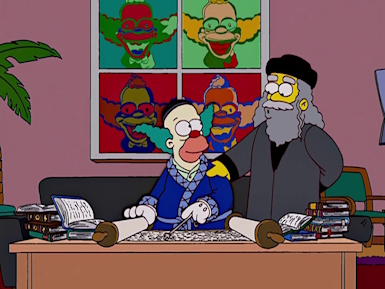
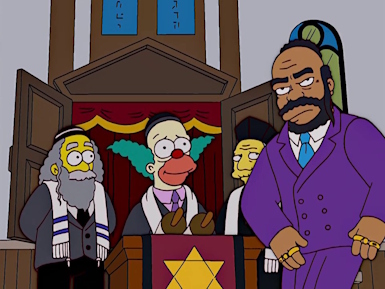
The episode, titled "Today, I Am A Clown" (buy it here; complete show in screengrabs, wikipedia entry, thoughtful summary and analysis, and full script) starts when Krusty discovers the Jewish Walk of Fame ("Where the Chosen Get Chosen"). He fumes when he sees Sandy Koufax' star: "I lost 10 grand when he wouldn't pitch on Yom Kippur. I did five shows that night!" (video). He wants his own star, but learns from the Springfield Jewish Walk of Fame Committee that, without a Bar Mitzvah, he's not really Jewish:
Krusty is in anguish: "I was turned down by all those country clubs for nothing! ... I thought I was a self-hating Jew, but it turns out I'm just a plain old antisemite!" Watch:
The episode also shows lots of Springfield's lower east side, the Jewish part of town:
Krusty prepares for his Bar Mitzvah with his father:
But he has some issues with the halakha; after his dad explains some fine points of Jewish law to him ("Now you can't mix milk and meat, and on Christmas day, you must eat Chinese food, and pork is strictly forbidden."), Krusty takes a bite of his sandwich, and moans:
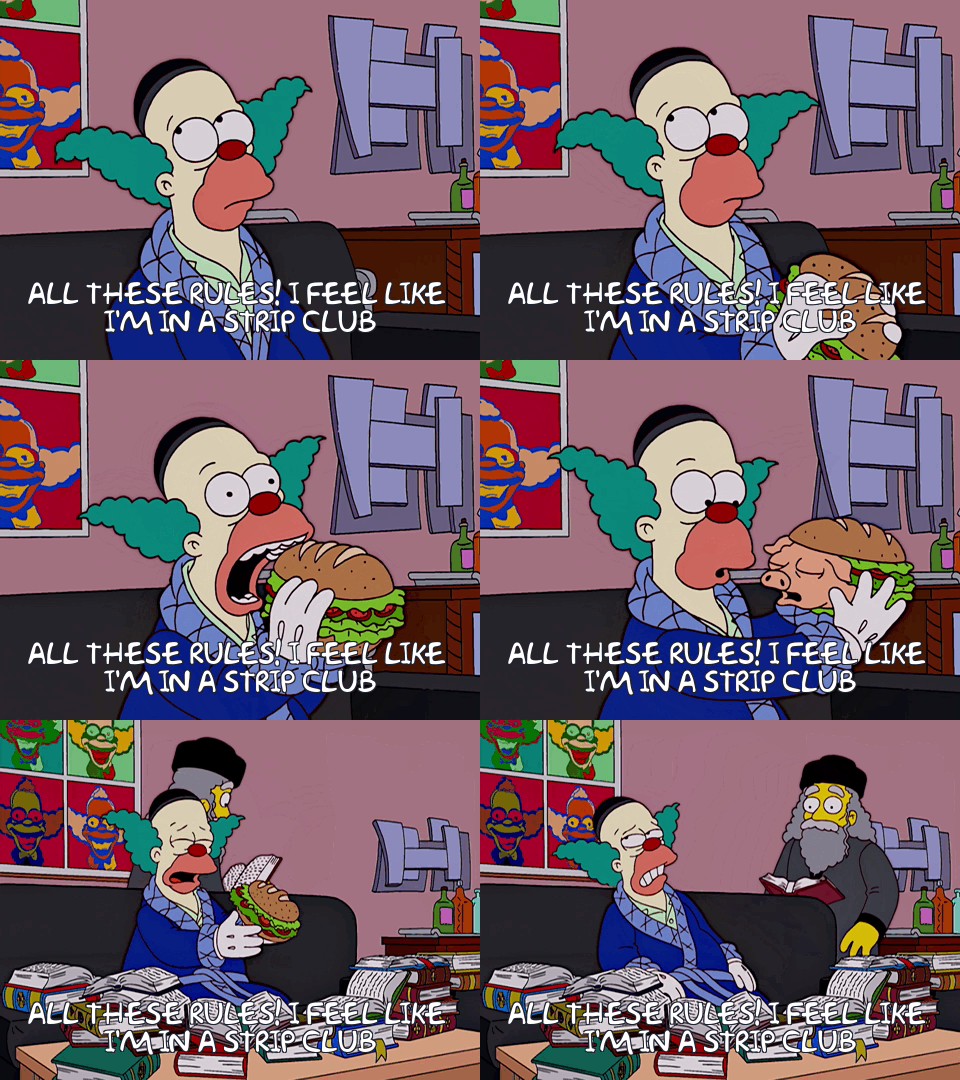
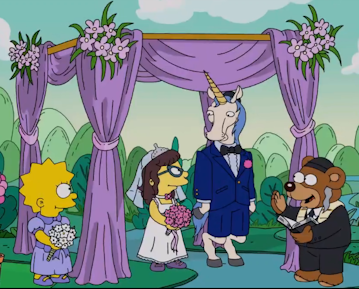
So Krusty has his televised "Wet 'n' Wild" Bar Mitzvah (the sign outside says "Warning: First Two Rows May Get Converted"), with Mr. T helping ("I pity the shul that won't let Krusty in now"). We also learn that Krusty's full name is Herschel Pinkus Yerucham Krustofski, and that Lisa has a Jewish imaginary friend ("Her name is Rachel Cohen. And she just got into Brandeis.") (Her Jewish imaginary friend Rachel shows up again in 2016's Treehouse of Horror Halloween episode, where Lisa imagines being a bridesmaid at Rachel's Jewish wedding, to a unicorn, under a chuppah, with a teddy-bear rabbi (see it here)).
The service is a televised stadium extravagaza:
At the service, the Beach Boys Experience sing, to the tune of Kokomo, this:
Mezuzah, menorah,
Reading from the Torah.
Pastrami, knishes,
On two sets of dishes.
A church with no steeple,
For God's chosen people.
Afterwards, Abba/Rabbi is relieved:
Krusty announces on his show that he's now Jewish, puts on a kippah, and shows an ultraviolent Itchy and Scratchy cartoon about circumcision, titled "A Briss Before Dying" (see it here).
Read a Jewishy review here ("Ultimately, the episode works because it doesn't resort to tired Jewish cliche in search of a good gag...it treats its Judaism with a positive attitude and a healthy dose of off-the-wall humour.") You can hear some soundclips and images from the episode here.
The episode, written by Joel Cohen, won the Jewish Image Excellence Award award from the National Foundation for Jewish Culture and the Los Angeles Entertainment Industry Council. At the awards ceremony, Laraine Newman said that "not since Bam-Bam's bris on the Flintstones" had Judaism played such a role in an animated series. Writing in the Jewish Week, Rabbi Joshua Hammerman saw Krusty's Bar Mitzvah as a turning point - "the proverbial tipping point when all of America became Jewish."
My jaw dropped when I saw this. I'm more than a casual watcher of "The Simpsons" (principally because just about every bar mitzvah student is able to quote it chapter and verse), so when I tuned in I was expecting the same old shtick for Krusty's bar mitzvah — an updated version of the excesses of "Goodbye Columbus." It started out that way, but ended up with Krusty headed on a serious Jewish journey.
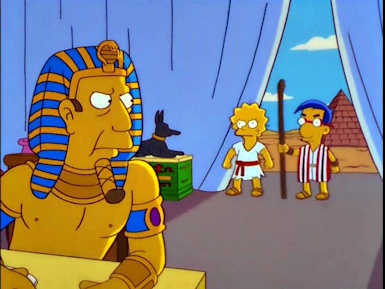
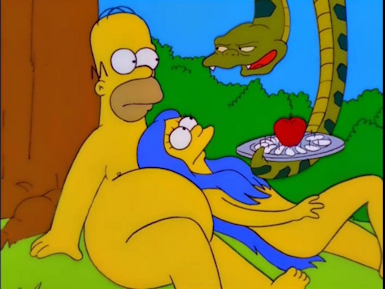
Even Tulsa's Sherwin Miller Museum of Jewish Art featured a promotional poster for the episode in an exhibition highlighting biblical images in art and popular culture. See the complete script and images from show here).
The episode starts with Adam (Homer) and Eve (Marge) in the Garden of Eden, where Adam is eating lots of apples, violating God's (Flanders) command. Adam persuades Eve to try one too. But God catches just Eve eating, and banishes her, but not Adam. Eventually they are both kicked out, but Eve optimistically says, "I'm sure God will let us return soon. I mean, how long can he hold a grudge?" Best line: when Eve/Marge takes a first bite of the apple: "This could really spice up those pies I've been making." Watch the whole 5-minute segment here.
Another segment features Bart as King David, who now has to fight Goliath's son, Goliath II (the bully Nelson). Along the way Methuselah, the story of Samson's hair, the Tower of Babel and Jonah get involved too. Watch this segment (5 minutes) here.
Another short segment has Homer on the throne as King Solomon. Lenny and Carl come before him, each claiming ownership of a single pie. The King cuts the pie in two, but then condemns each of them to death, so he can eat the whole thing himself. Watch it (just 35 seconds) here.
But the best and most omer-worthy one tells the story of the Exodus from Egypt, with Milhouse as Moses, Lisa kinda playing Aaron, Skinner as Pharaoh, and the school children as the Israelite slaves.
After Moses asks to "let my people go," Pharoah's guard throws Moses and Lisa into a pyramid, with the guard telling them, "Give my regards to the British Museum." The splitting of the sea is caused by all the Israelites flushing toilets at the same time, but the Egyptian troops caught in the sea when the waters return have lots of fun splashing and playing water games.
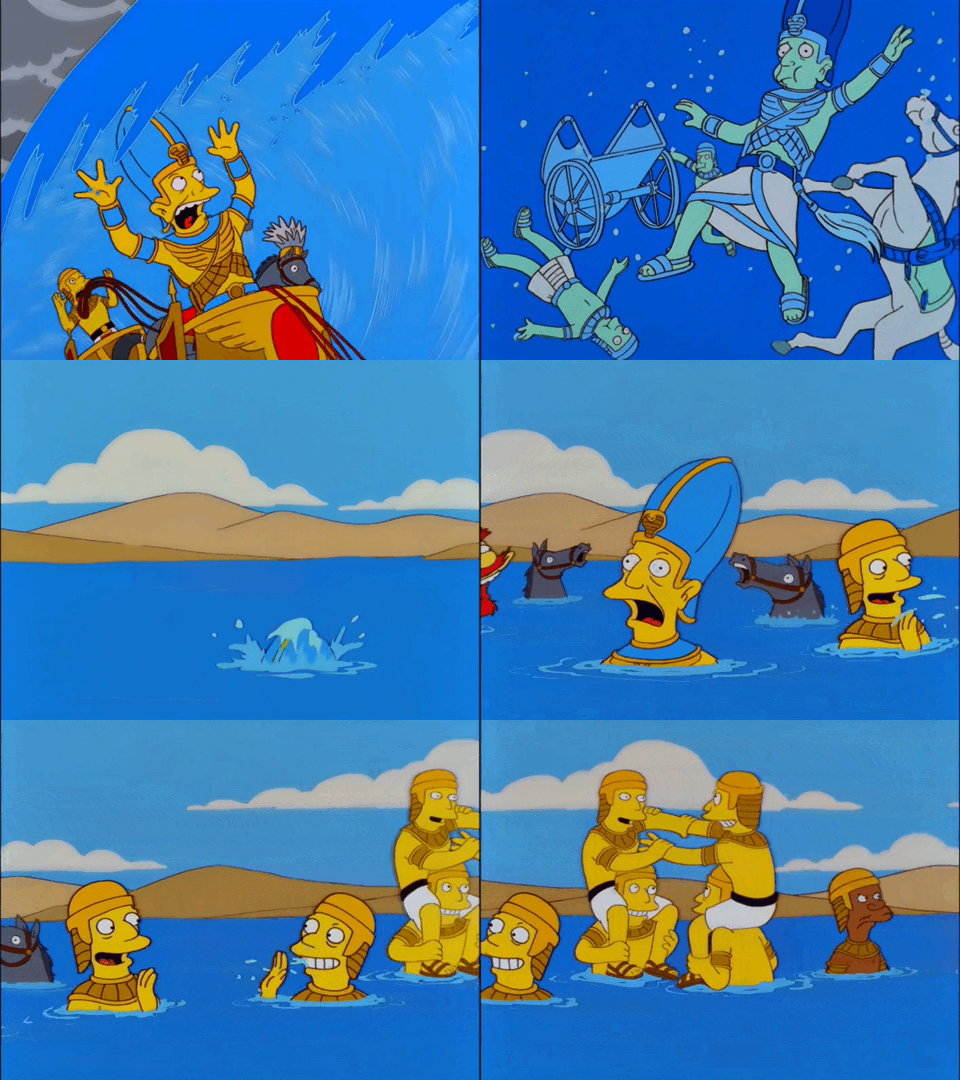
As the Israelites make it out of Egypt, Moses asks a question:
Moses: Well, Lisa, we're out of Egypt. So, what's next for the Israelites? Land of milk and honey?
Lisa (consulting scroll): Hmmmm. Well, actually it looks like we're in for 40 years of wandering the desert.
Milhouse: Forty years? But after that, it's clear sailing for the Jews, right?
Lisa: [quavering] Uhh... more or less... [pointing away] Hey, is that manna?
Watch the segment here:
Max Castleman reports an astonishing bit of Simpsons religious history about this episode:
Here's an amusing anecdote: apparently director Nancy Kruse was worried that the animation team wouldn't want to do the episode because many of the "very religious" crew members would be offended by the content. But then it turned out they didn't mind because they were all Old Testament jokes. So, basically, a bunch of devout Christian people looked at the script and said "It's okay, they're only making fun of the Jews!" There's literally one joke about Jesus in the whole episode, and that is the single joke that one of the animators refused to work on. Jesus Christ, guys, lighten up. I'm a Jew, and I don't care that the episode implies that Moses parted the red sea by flushing a bunch of toilets. I don't even care that the episode implies that Moses was Milhouse. Now let's all drink some Manischewitz and forget our troubles.
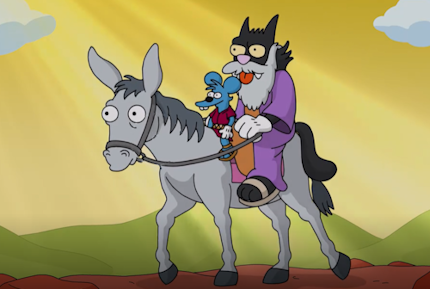
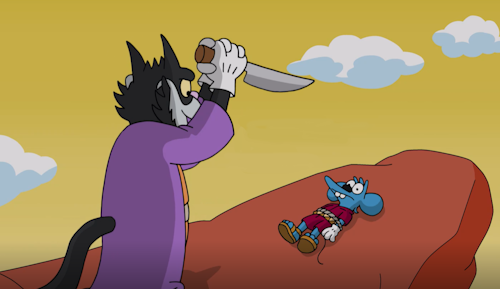
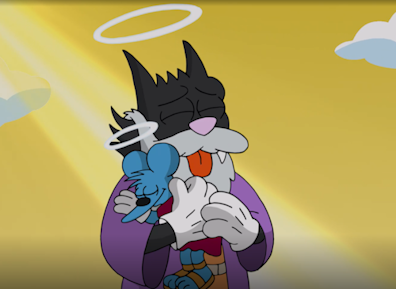
Some more Torah showed up in October 2026. Bart, Lisa and the other kids are in church Sunday school. The teacher shows them an Itchy and Scratchy cartoon, "The Greatest Gory Ever Told." Scratchy (the cat) is Abraham, riding a donkey through desert, with a baby mouse (Itchy). God calls out, "Abraham, take your son Isaac to the Land of Moriah, and make him a sacrifice unto me." Itchy is tied up on rock, Scratchy raises his knife, ready to sacrifice, and Bart is excited: "Stab the baby in the face!" But God calls it off and blesses them, as they hug. The kids, though, are furious. Back in class, Millhouse asks, "what is this 'nice' crap." Bart: "Why the hell are Itchy and Scratchy shilling for God?" (see Youtube clip)
(Bonus: Aseret Hadibrot and Moshe Rabbenu also make an appearance in a 1991 episode:)
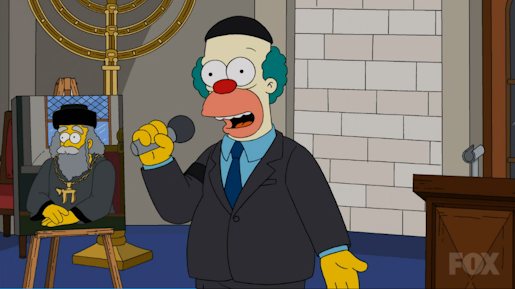
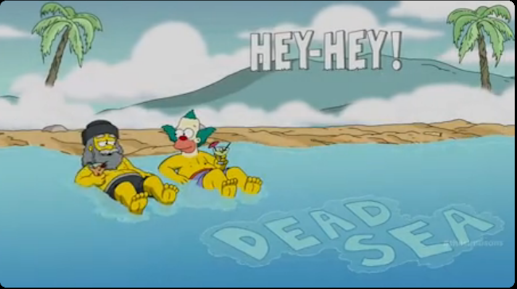
The episode garnered lots of attention in the Jewish and non-Jewish world. Highlights:
ET covered the story as newsworthy:
Here's a quick clip of the Rabbi's funeral choir, singing, "He fought, and fought, and fought, for Jewish rights" to the tune of the Itchy and Scratchy theme:
Jewish fans were on edge before the episode aired, as the kippah-laden promotional graphic (see it) made some worry that perhaps it was Krusty himself who was off to the world to come.
The rabbi's death was big news in the both the Jewish and non-Jewish world, prompting major headlines and obituaries, with some Yiddishkeit snuck in, like Time Magazine jolly ("Fans of The Simpsons will be sitting shiva tonight"); Time Magazine profound (there was a brilliant absurdity to leaving Krusty with that Talmudic, torturously ambiguous "Eh" - that most malleable of Jewish judgments - leaving Krusty to decide, on his own, whether his life has been worth it); the English feed of Israel Broadcasting (video), which played it as a serious news story; or this JTA story ("For diehard Jewish fans of "The Simpsons," a Mourner's Kaddish will be in order at this weekend's Yom Kippur services"); Tablet also suggested a Kaddish might be recited. The character's death also played big in the UK, in part because of a campaign in 2012 to have Rabbi K selected as chief Rabbi of Britain, with its own Facebook page and Twitter feed. So Krustofski's death was covered big (Here's the UK Jewish Telegraph's spread, and here's the obit in the London Jewish Chronicle).
The episode is full of Jewishy humor, and some serious Jewish meaning. Krusty dreams of Jewish Heaven, where even Portnoy has no complaints. There, lumberjacks cut down slices from the Kosher pickle forest, and there's free egg creams at Ebbets Field where the Brooklyn Dodgers play the NY Giants. At the Oys 'R' Us store (see it here), a sign says, "The whole store is a complaint department." Meanwhile, people line up at the Joe Lieberman Presidential Library.
Krusty's heavenly reverie is interrupted by his father, looking Moses-like. "Schmuck," he calls out. "There's no Jewish heaven. Our faith teaches us that once you're dead, that's it. Kaput. It's dark, it's cold, it's like that apartment we lived in before I started doing weddings. ... Go back to earth! Do something with your life! Help people!" Watch:
Some pictures from the episode:
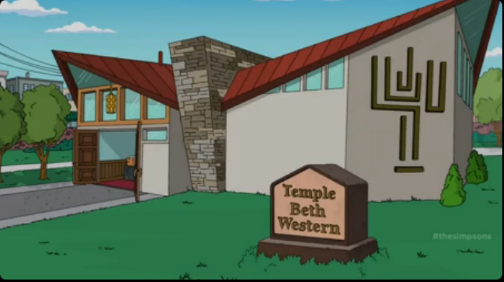
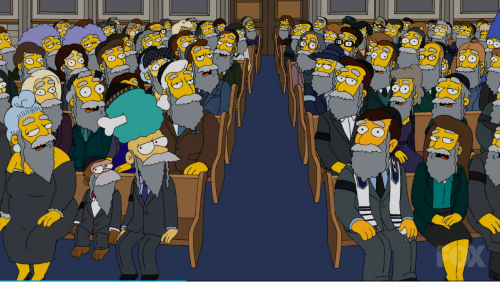
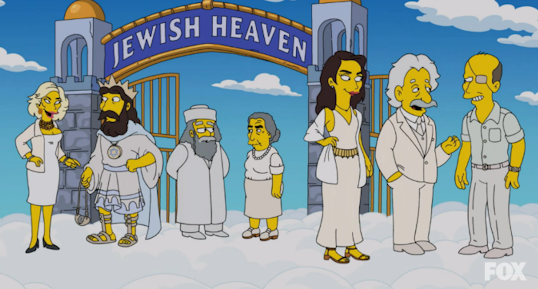
At the end, Bart and Krusty visit Temple Beth Western, where Rabbi Rosenstein is getting big laughs by telling Krusty's lame jokes. And, despite the Rabbi's admonition, the episode ends with both Krusty and the Rabbi entering and singing about Jewish Heaven, where the Irving Berlin Orchestra plays for some well-known dancers (see picture here (and by the way, JHeaven shows up again in 2018, looking more heavenly, but this time with the Rav, some more famous folks (Israeli, mostly) and the very-much-alive Gal Gadot, a guest voice in the episode, who somehow gets invited to visit - see it).
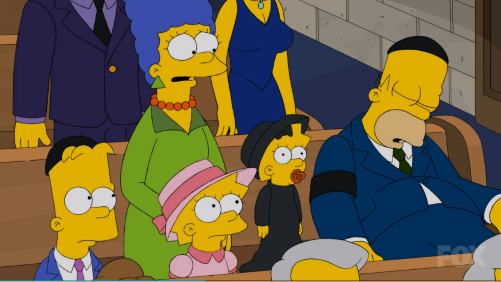
In the episode, Temple Beth Western hosts a very authentic-looking shiva (see clip). The episode ended with a klezmer version of the closing theme music. Later, in both December 2014 and 2017, during the opening credits sequence for the Christmas show, the scene pans across the Jews of Springfield eating Chinese food. Hovering behind them are the ghosts of Rabbi Krustofski and Joan Rivers (see picture).
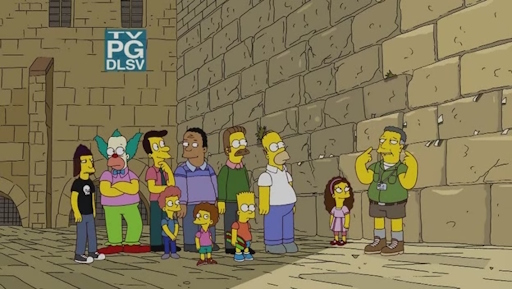
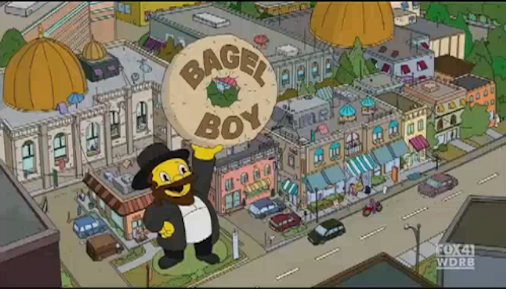
The Israel episode set almost all the scenes in Jerusalem, and feature very accurate depictions of the Tomb of King David on Mt. Zion, the Kotel/Western Wall, the Church of the Holy Sepulchre, and the Dome of the Rock. Some links: Wikipedia episode summary; complete scene-by-scene walkthrough from the Jewish Journal; Beliefnet review ("Israel has survived a great many things - and last night, the country survived the arrival of the Simpsons"); Heeb's and Ma'ariv's Hebrew take.
See some excerpts here (YouTube clip), or watch highlights below:
You can also watch Aish's "JTube" compilation, or a short video excerpt with Hebrew subtitles, the way I first watched the show, here.
The episode featured Sacha Baron Cohen, speaking some Hebrew, as a pushy Israeli tour guide, and Israeli singer Yael Naim as his neice and tour security guard. The guide was Israeli gruff and surly, prompting a 2026 Reddit discussion about if it was accurate portrayal of Israelis (consensus: exaggerated, but not too far off). There were lots of Simpsons-style sight gags (the Wailing Waldorf hotel, and Krusty slips off to the Gaza Strip Club), a long stream of Hebrew invective from Cohen (probably the longest bloc of Hebrew in American prime time ever? - watch it), and a fair amount of Simpsons schmaltz. There's a weird coda with Jewish Transformers robots stopping for Shabbat and contemplating Torah.
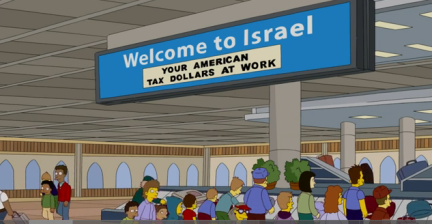
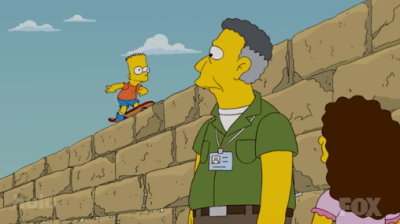
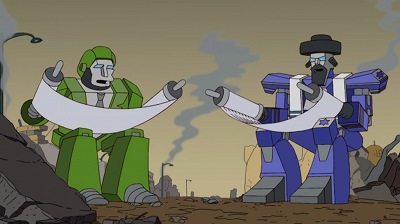
Even before the show aired, groups started weighing in, opining on the deeper meanings. The American Family Association, a far-right Christian group, called on Fox to pull the "horrific" episode they hadn't seen: "As Christians we are appalled.... This animated program has gone from inappropriate, to crude, to now offensive.... Families should not be exposed to this toxic poison." Meanwhile, Rabbi Brad Hirschfield, president of Clal–The National Jewish Center for Learning and Leadership, waxed incoherently: "These journeys can remind they wake up our angels, such as our need to unify as Homer has, but also our ugliest demons, like suddenly thinking you're the Messiah. It reminds us that Jerusalem is important to lots of people and lots of traditions. If it weren't, the Simpsons couldn't use it as a spot for their journey of self-discovery." Worst was an anti-Israel blogger who attacked the unseen episode for showing Israelis as humans (really: "The Simpsons prepares to jump the shark in an orgy of Jewish self-congratulations (with no reference whatsoever to 'politics'). On the hasbara bandwagon, making monsters look like human beings.").
But Bart apparently did have a good time b'aretz, at least according to an Isareli version of the "Radical Dude" t-shirt (see it), which replaced his phrase "Don't Have a Cow Man!" with "I got Chai in Israel."
Israel also showed up in 2006. The Simpsons are on a cruise, and Lisa points out the elderly Jewish couple making their first trip to Israel (Wife: Our son Shlomo is working on a kibbutz in Haifa. We're shlepping his some kreplach. Husband: We're Jewish all right." — see the clip). And in a May 2022 episode, Krusty goes back to haäretz. He loses everything, and decides to go to Israel to work on a kibbutz (see picture from the show, and read about the real kibbutz where it came from here). Wearing a kippah, he's pulling potatoes in the field when a helicopter flies up and he's told he can come back to show business. He puts on his nose and hair, says, "I can be a clown again!" and laughs as he climbs the rope ladder up to the helicopter. The kibbutznik working with him shakes his head and says, "He was a clown? He's like the least funny person on this socialist commune."
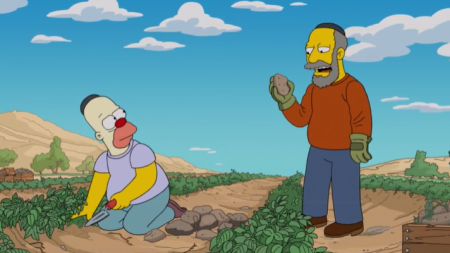
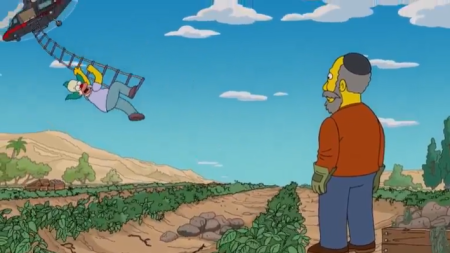
More: Some of this and more are included in a YouTube video that is an eight-minute jumbled compilation of every Simpsons scene mentioning or set in Israel, here.
I fell in love with our favorite mishpacha in Israel, where the show was a big hit for years. Unfortunately, things did not go as well for the show in the Arab world, or in Iran. What's worse, in 2014, Egyptian TV reported on the strange "Zionist plot," where a 2001 Simpsons episode magically inspired or predicted the Syrian opposition that arose 10 years later (lots more bizarre details in this NY Times story).
In the Halloween 2011 Treehouse of Horror episode, Bart (as the alien in an Avatar parody) engages in his first intergalactic sex. Rabbi K floats by in Bart's mind's eye and proclaims, "Today, you are a man. Mazel Tov!" Mason also had very brief cameos in December 2011, and the series' 500th episode, aired in February 2012.
In January, 2010, Rabbi Krustofski appeared in an episode with an intermarriage theme (Forward commentary). It was the most-watched episode in 5 years. In the show, Krusty is set to marry a non-Jewish princess, voiced by Anne Hathaway, who won an Emmy for the role. His Rabbi/father starts the wedding under a chuppah with real Hebrew blessings (see picture), but is not happy. Bart interferes with the wedding, but they get together in the end anyway, with Krusty declaring, "I'd rather be a happy schnook than a noble shlumpf." The most bizarre image was Mr. Teeny, Krusty's chimpanzee, who was locked in the "Torah Room" by Bart. The monkey is seen rolling out the Torah scrolls with glee (click for picture, and click on picture again and again for two more frames), which kinda offended at least a few frum folks.
Watch the clip here:
Even following his character's death, Jackie Mason returned as Rabbi K regularly. In a December, 2016 episode, a vision of the Rabbi's ghost as a snowman talked to Krusty after he was pulled frozen from an icy river. Krusty was in the water to be baptized, but then he was treated by an Orthodox Jewish ambulance service, where they put a tallit and kippah on him (you gotta see the picture here). Afterwards, in the episode's epilogue, the Christian God and Jewish God sit in lounge chairs in heaven, and discuss Krusty's soul (see picture here, and notice God's face is never shown). The Jewish God says, "Sorry about Krusty, but he's still on Team Hanukkah." But the Christian God responds,"Um, I hate to win on a technicality, but he was under the water. That's a baptism."
In 2018, the late Rabbi showed up as an angel (see picture) in January, and showed up again in April, as a vision talking to Krusty. Jackie Mason had no trouble with the Yiddish, as he said, "You used to be a putz, trying to be a schmendrick, which makes you a schmeckle". And Mason had a few lines again in May 2018, when Bart is able to see the dead, including Rabbi K (picture). And, again the late Rabbi shows up with other deceased characters at a depressed Bart's birthday party in a September 2024 episode, with Bart crying out, "and you guys are dead!" (see it). Jackie Mason z"l passed away in 2021, but the show used some archived audio from 2014 as Rabbi K appears as a hologram when his daughter Sophie marries bully Jimbo in a 2022 episode set in the future (see the video).
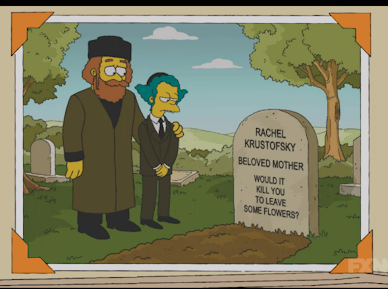
And speaking of Rabbi K z"l, an October 2016 episode included a Jewish funeral scene (see picture here). In the background is Rabbi Krustosky's (with a y) grave (also shown are graves inscribed, "OY," "At least I'm off my feet," "You call these flowers?" and "Rich Jewish Texan")(and, speaking of funeral flowers, the inscription on Rachel Krustofsky's grave, the Rabbi's late wife, reads, "Would it kill you to leave some flowers" - see it). During the funeral, the rocks left by mourners on top of the Rabbi's grave are used to throw at Mr. Burns (picture). With the old Rabbi gone, there's always a new one. In a January 2019 episode, Lisa bicycles past Temple Beth Springfield, just as their new Rabbi sneaks out the window. The Temple has a sign out front, "In loving memory of Rabbi Hyman Krustofsky" (see it).
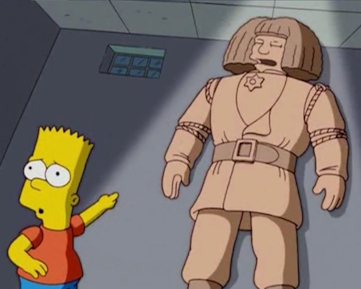
See the Golem episode synopsis here; and thoughtful video summary/review. As Krusty described him, the Golem is "the legendary defender of the Jews, like Alan Dershowitz, but with a conscience." The Golem looks like the silent film Golem and tracks the Jewish legend. The Golem is voiced by Richard Lewis, who feels Jewish guilt for being used to commit heinous acts. He also does some jokes: That's what we call Jewish humor. You don't have to understand it, because the words sound funny: Meshuganah! - hilarious. ... My stomach feels like I'm hosting a Chabad telethon, and Norm Crosby's going long. Watch:
To make him feel better, the Simpsons create a female golem, voiced by a grating Fran Drescher:
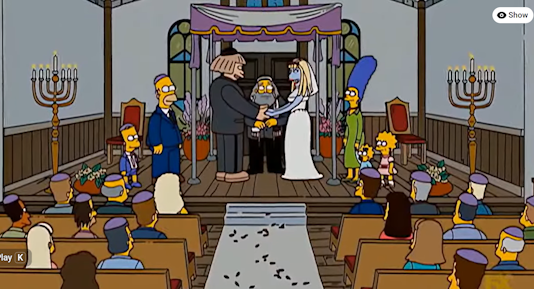
They then get married, in a Jewish ceremony presided over by Rabbi K (see chuppah picture).
Serious Jews began right away dissecting the meaning of the episode, mostly deciding it was Bad. For. The. Jews. Like the culture critics at Tablet/Nextbook, the popular webzine Jewcy ("Why the Golem Episode of the Simpsons Was So God-Awful: A Close Reading"), and the Jewish Outreach Institute who worried it would harm, well, outreach ("to unaffiliated Jews the jokes may seem foreign or even offensive. For those of other religions who are married to or involved in relationships with Jewish partners such representations may be confusing and the fact that they do not "get them" may ossify their already present feeling of being an outsider to the community"). The exception was the multi-religious site Beliefnet, which praised Fox for exposing another generation to the Golem tale. There's no question about that; internet searches for the term "golem" soared following the show.
And speaking of weddings, in a 2020 episode, Artie Ziff, a rich Jewish nerd who has been after Marge since high school, marries a robot he made to look like Marge. It's a Jewish ceremony, with a Rabbi, of course (see a picture of his kinda-sorta chuppah wedding here) (and see another wedding-with-rabbi-and-chuppah here, from a 2024 episode, where a valuable bottle of wine rolled into the scene, and was almost stomped on by the groom).
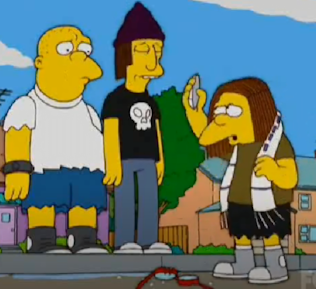
Dolph was orignally referred to as "Dolph Starbeam" in the show, but later was called "Dolph Shapiro." After convincing Milhouse that cool kids ride their bikes with their eyes closed (Milhouse gets hit by a train), Dolph whips a tallit and kippah out of his pocket, puts them on, and exclaims, "I'm outta here. I've got Hebrew school." He chants "Baruch atah adonai, eloheinu melech ha-olam," with decent pronunciation, as he walks away:
No Jewish authorities opined on any deeper meaning, however. In an episode the next year, Dolph reveals that they went to the Clam-Elot Seafood Restaurant after his "just family" Bar Mitzvah. And in a January 2018 episode, Dolph trips a kid, who then starts singing about his pain. Dolph says, "He turned his suffering into entertainment, just like the Jewish People."
Also in the bad-guy-does-Jewish category is the lifelong criminal Snake. In an April 2020, episode, he enters the home of the hip new pastor:Snake: I want redemption or else, dude! [makes threatening fist](see picture)
Pastor: or else what?
Snake: ... or Rabbi Mankiewicz will, dude. [takes out kippah from pocket and puts it on]. I have trouble making that choh sound. It's either Tschanukkah or Hanukkah, OK? Pick one of those.
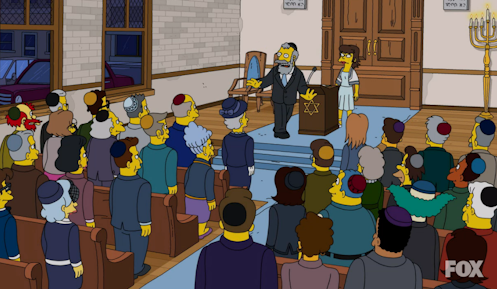
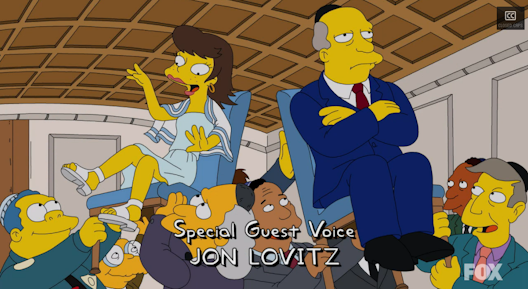
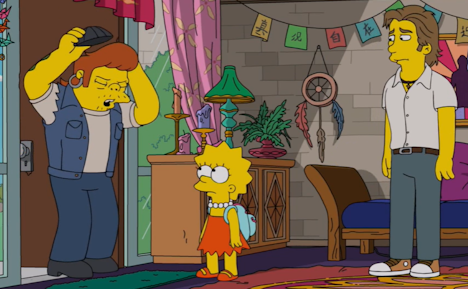
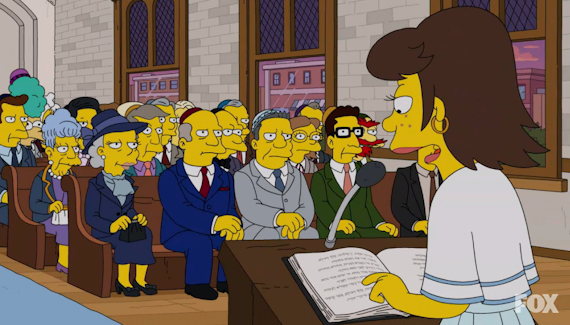
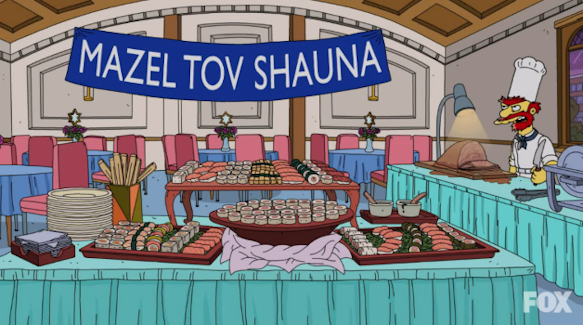
It starts by her reciting the full "Poke'ach Ivrim" morning blessing, in Hebrew. Impatient dad looks at his watch, saying, "Come on, sweetie, pick up the pace. The sushi's been sitting out for an hour" Cut to the end of the service, and she triumphantly yells out, "And now we're gonna party like it's 5799!" After that, they throw in an old joke:
Rabbi: Wait, wait, wait. Before you leave, I am going to talk. And I'm going to tell you a very long joke. Please stand. So, an old rabbi was confronted with squirrels in the attic. ...
Superintendent Chalmers (angrily): Get to the punch line or your son flunks geometry.
Rabbi (quickly): He gave the squirrels a bar mitzvah and never saw them in temple again. Amen.
Florida journalist Mark I. Pinsky has some Jewish musings in his book, The
Gospel According to The Simpsons. The book
examines the role religion plays in The Simpsons, and
includes a detailed discussion of the Simpsons and the
Jews. He updated it an an e-book, "A Newer Testament," covering 2007-2016. Pinsky identifies what he calls an "underlying
element of what might be called 'crypto-Judaism'"
permeating the show. Read an excerpt, including a quote from, well, me:
In 2007, Moment magazine
published his article,
Do You Know This Family?,
which sees the Simpsons' Springfield as a modern-day
Chelm, and Krusty, despite having worked 5 shows on
the Yom Kippur that Sandy Koufax sat out (he also lost
$10,000 betting on the Dodgers that day), as embodying
the American Jewish experience. He continued his thoughts in the Forward in 2014, "For 25 Years, The Simpsons Has Been Good For the Jews." Richard Kalman and
Josh Belkin see more than echoes of crypto-Judaism in
the show; they propose that the Simpsons are Sephardic
crypto-Jews themselves. The show "displays a knowledge
of the Sephardic tradition that would make Rabbi Moses
ben Maimon blush." Read their detailed, engrossing
article, Sephardic
Tradition and "The Simpsons" Connections. For years, Jewish educators have been using the Simpsons to sell
Jewish content. For example, Sinai Temple in Los
Angeles had a Torah study class that watched 10
Simpsons episodes "as
a springboard for deeper discussions on Jewish beliefs
and values," and Limmud London included a
session, The Wisdom of the Simpsons: Learning
Jewish Values from our Favourite Animated Family
("You've heard of Pirkei Avot; now it's time to study
Pirkei Simpsons"). We heard a few years back from the
educator at the New North London Synagogue, who was
using the Calendar with her 5th graders, and also has
a Simpsons mock seder, acts out the weekly Torah
portion Simpsons style, and has the students discuss
how Bart and Lisa would have reacted to Egyptian
slavery. And Rabbi Jeffrey Mitelman asked in 2014, What (and How) The Simpsons Can Teach Us All" (answer: why you should learn Hebrew, somehow). Also in the U.K., Rabbi Emeritus Josh Levy of Alyth Congregation in North West London offered a D'var Torah in 2015 that includes us:
The release in 2007 of The Simpsons Movie prompted the
Jewish Outreach Institute to suggest using the film to
somehow "encourage participation in Jewish community." They even
recommend using the Hebrew-dubbed version released in
Israel (Jersualem Post: Eat my 'tachtonim'?) for an introductory Hebrew course. Or for the more traditional, Rabbi Uri C.
Cohen of Princeton has given a talk called "Religion
and the Simpsons: HaDat vehaD'oh!" And try listening to
this 2003 shiur titled "Simpsons in Halakha" by Orthodox
Rabbi Daniel Z. Feldman. Jewish
Simpsons producer Mike Reiss ("I'm not gay, but I'm
Jewish, which is basically the same. Both gays and
Jews have been persecuted for centuries -- by their
mothers.") says
his Jewish talk is his favorite. He's always on
the circuit. He's even talked about Simpsons and the Jews in
Mumbai, Singapore, Macao and Chile. I saw him in Boston in 2019, and it's very funny, but the Jews-in-the-Simpsons content in the talk is very thin. In 2004, he gave
the Irving Blum Memorial Seminar at
the Pikesville, MD, Beth Tfiloh Synagogue. This
prompted an angry letter to the editor objecting to
"promoting 'The Simpsons' vulgar attitudes in shul." You, too can book Reiss to speak, via the Jewish Speakers Bureau. Check out his history of Moses on The Simpsons, on page 7 of their Haggadah supplement.The Jewish content of The Simpsons inspired one fan, Brian Rosman, ... to create a Web site that features still shots from "Like Father, Like Clown" under the heading, "Jewish Life in Springfield." It also uses Homer Simpson to help Jewish viewers with the observance of Lag B'Omer, the counting of the sheaves between Passover and Shavuot, the Feast of Weeks, and a bilingual pun on Homer's name. Rosman believes that:
"The Simpsons does the funniest, most authentic parodies of Jewish life among all the comedy shows on TV, certainly compared to shows that are considered more "Jewish," like Seinfeld. The Simpsons demonstrates a more intuitive understanding of American Jewish history, Jewish religion and culture, and Judaism's place among all the other varieties of belief and identity in America. I only wish there was more Jewish content on the show, because when they do it, they do it very well."
But, unquestionably, the most popular, and most enjoyable way to look it up [the omer count] is this: The Homer Calendar.
Now, you might think that this is slightly disrespectful - But it actually reflects a little appreciated truth - that of all the programmes on TV the one that really understands, and grapples with the issues of modern day religion - that programme is The Simpsons....
Judaism is also explored - through Krusty the Clown and his father Rabbi Hyman Krustofsky, originally voiced by Jackie Mason - for whom there was a brief campaign on twitter that he succeed Jonathan Sacks in the Orthodox Chief Rabbinate.
Since the last Pesach, Rabbi Krustofsky has sadly died, his last words in life being to tell his son that he is less funny than the Simpsons equivalent of Jackie Mason (a man who puts the Levity in Leviticus, noch). In a very Simpsons chain of events, this provoked Krusty to drink too much, which itself led him to have an out of body experience - a vision of a Jewish heaven. There, his father came to him and admonished him because Jews, he says, don't really believe in heaven (see, I told you the Simpsons known religion).
And he ends with this message to his son, which is as good an analysis of Jewish opinion of the afterlife, and of how we should be, as anyone can ever give, and which seem an appropriate way to end a dvar torah on the first Shabbat of this year's Homer period:
Rabbi Krustofsky's final words on the Simpsons:
Go back to earth; do something with your life; help people.
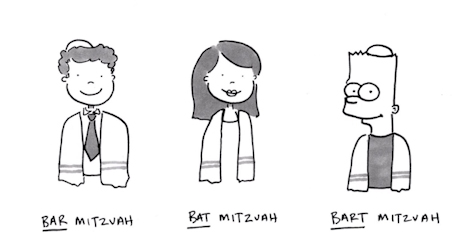
Cartoon from author and illustrator Tim Brierley
For decades, lots of people have gone public with their sudden revelation that "Bart Mitzvah" could be both a gender-neutral term and a jokey Simpsons reference. That's fine.
But then there are the Simpsons-themed "Bart" Mitzvahs, for real ("the clever decor featured bright cartoon colors, a Moe's tavern airbrushed backdrop behind the bar, a Simpson's living room backdrop for photos with lifesized figures of Homer, Marge, Bart, Lisa and the baby, and mountains of frosted donuts on the sweet table"). The ultra-fancy Tavern on the Green hosted one - see some pictures, and some more with the centerpieces, cake ("fondant remote controls, frothy mugs, cans of "Duff" root beer, and donuts covered each of the tiers") and fake Moe's Tavern set-up.
The Bart Mitzvah boy can wear a busha of a "Shalom Dude" t-shirt, or one where Bart-Mitzvahman declares that "I had a cow at Michael's Bart Mitzvah 5-4-91, or this one from Eitan's party, weirdly also from May 4, 1991, or from Jason or Michael (shirt images from Bootleg Bart, who says they were kicked off Instagram, Facebook and YouTube, with no appeal, but still survives on Twitter, and a replacement Insta).
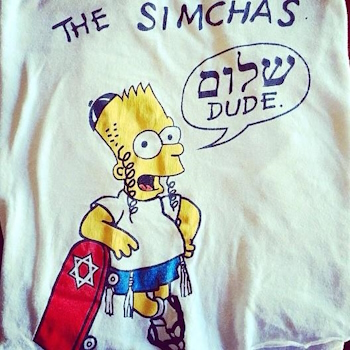
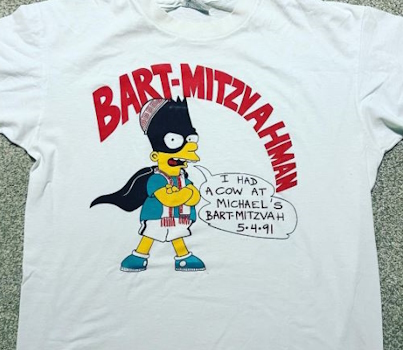
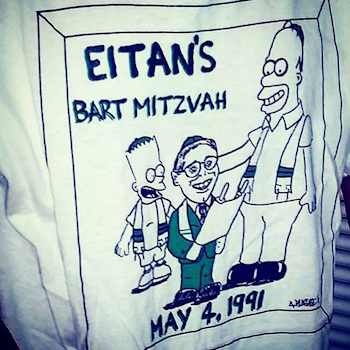
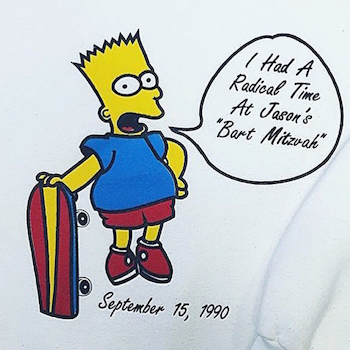
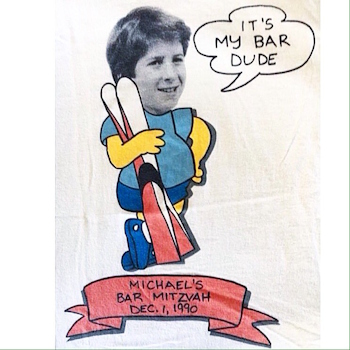
(Of course, none of these Bart Mitzvah shirt images come close to matching the real thing:)
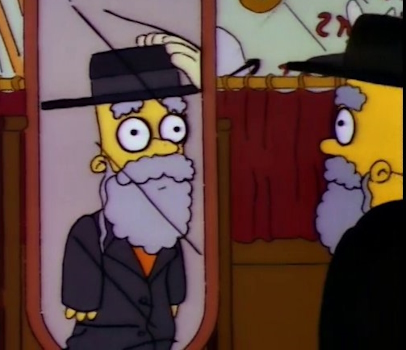
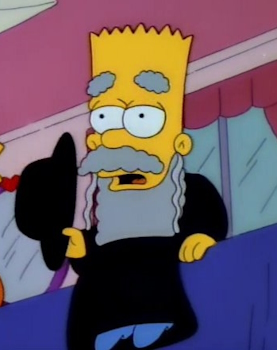
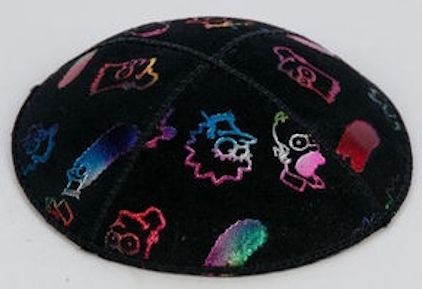
For a Bart Mitzvah you can also have a Bart-Mitzvah candle ceremony and for the service you can always order a Simpsons kippah: strange colors embossed, classy embossed, cut from fabric, cut from stranger fabric, painted (and listed on Amazon as "Hand-painted Kippah (Yarmulke) with a Square-Headed Kid and his Father") and two really, really bad kippot auctioned from the estate of Simpsons co-creator Sam Simon z"l: "Yeled Tov" and strange weightlifter? Bart. At kiddush you can serve a custom Mazel tov blackboard gag cake, or character cookies. And at the party, you can show this odd "Bart Simpson Bar Mitzvah" video put together in 1991 by Israei Dafna Peled, maybe for a family Bar Mitzvah, with clips of Bart's birth, childhood, and getting older, mixed in with Bar Mitzvah party scenes, with audio at times of Torah leyning and a Mazel Tov song.
But, it's not all awful. On the other side, a tip of the kippah to the Orthodox Anshi S'fard in Atlanta for their Simpsons Purim in 2020, where Rabbi Avraham Horvitz read the Megillah using different voices for the different characters in the Purim story. There also was a Simpsons-themed slide show of the Purim story at the same time as the Megillah reading. And even more astoundingly amazing is a video of a biblical Hebrew translation of the plot of the Steamed Hams Simpsons shorts segment from 1996, from Isaac Meyer, sung to Purim Megilla trope, with pictures from the episode and English translation. This is truly worth watching if you're into this, here.
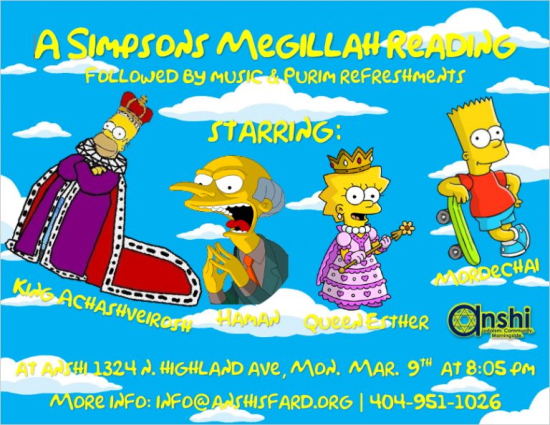
But the keter shem tov goes to this carefully, beautifully, edited video that inserts the Bar Mitzvah boy into the Simpsons world. It's for Jake Silversmith, who became Bar Mitzvah in 2018 at Congregation Beth Tikvah Ahavat Shalom Nusach Hoari in Dollard des Ormeaux, Québec ('shkoyach to Terranian Productions):
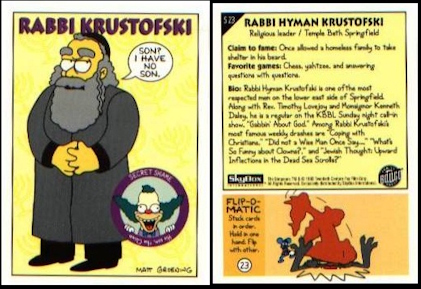
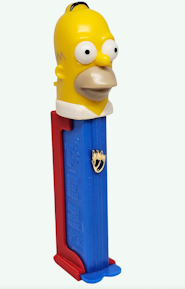
The Simpsons Collectible Card set included a nice Rabbi Krustofski card (see it). But fans were very disappointed when the Playmates toy company canceled their planned Rabbi Krustofski action figure. Playmates had produced a prototype (with a Torah accessory!) and started promoting the figure, with Jackie Mason providing the built-in voice. But it was shelved, supposedly due to Mason's worry that it would be seen as offensive. Fans were so disappointed that some put together amazing home-made versions.
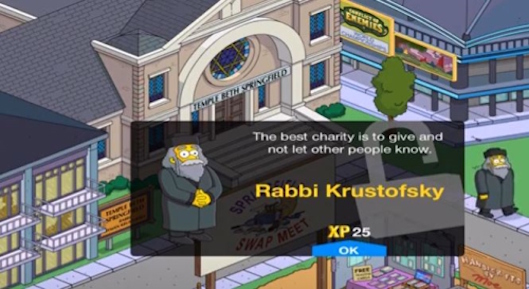
Even The Simpsons: Tapped Out video game had a module that lets you build Temple Beth Springfield and play as the Rabbi. Some of the scenes are a little wierd, and they seem to not always know how a Torah is read, but look at the powerful hagbah.
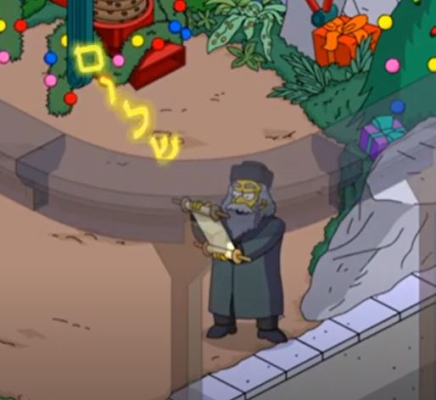
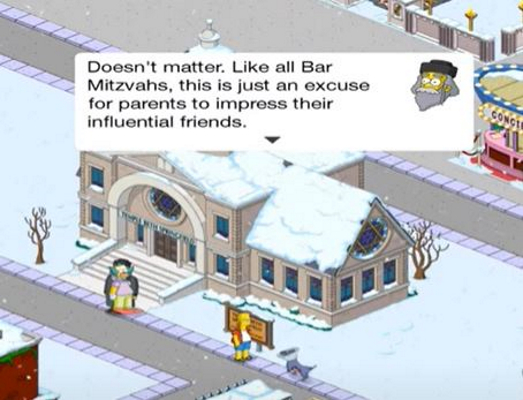
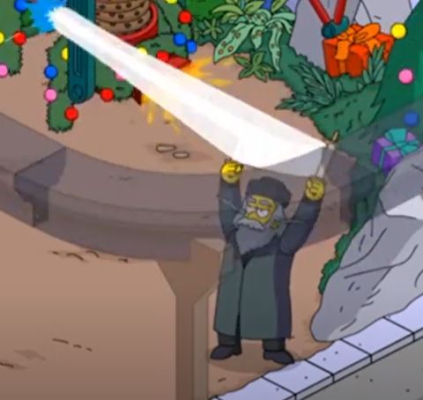
You can watch a complete run-through of the Rabbi section of the game here. The Old Jewish Man character is also in the game, and you can hear all of his lines here (YouTube). This article explains to those goyishe Tapped Out game players who may not have been paying attention who the Rabbi is and why he appears in the game, and is also a very good summary of much of Jewish content on The Simpsons (present company excepted, of course).
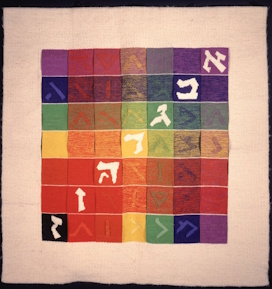
"About Counting the
Omer" adapted from the Reconstructionist
prayerbook series, Kol Haneshamah.
For more on counting the omer, follow these links:
Comments? Questions? Errors? Just want to shmooze? Let
us know via our @homercalendar Facebook page, or email us: homercalendar@mail2homer.com
Check our omer dates here, courtesy of Irv Bromberg's Kalendis program: omer calendar inside Israel and outside of Israel.
Legal Notice and Disclaimer: "The Simpsons" TM and © Fox and its related companies. All rights reserved. This web site,
its creators and any reproduction, duplication or distribution of any content
on this site relating to "The Simpsons" are not authorized by Fox.
;)
;)
;)
;)
;)
;)
;)
;)